
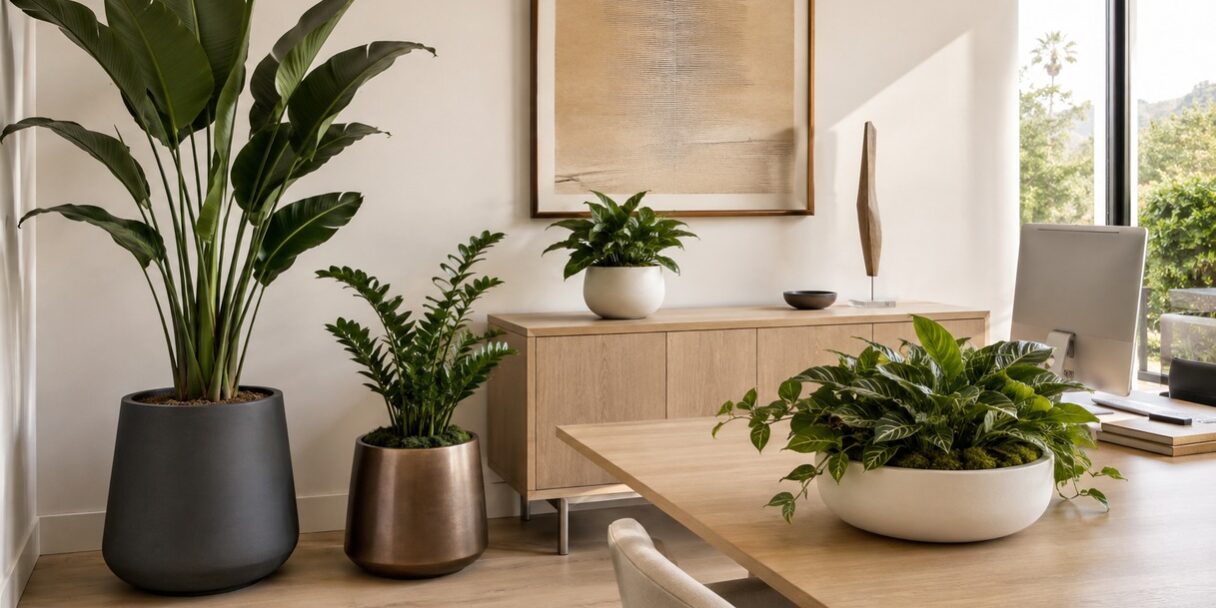
A planter looks like a decorating choice, and it is, but it is also a plant health choice. If you are wondering how to choose an indoor planter, start with the root ball and how water will move, then work outward to size, weight, floor protection, and style. That order keeps the plant healthy and makes the room look finished. Here is how we approach it.
How large should an indoor planter be?
Measure the pot the plant is in now, not the plant itself. For tabletop and mid-size plants, a container about one to two inches wider in diameter is usually right. For floor plants and trees, two to three inches wider is a safer step up.
Bigger is not better. An oversized container holds more soil than the roots can use, so that soil stays wet longer. Too small, and the plant dries out fast and the roots begin to circle. Depth counts as well, so a deep root system needs a deeper container, not a wider one.
Why drainage, liners, and saucers matter
Most decorative planters have no drainage holes. Either choose a planter with holes and pair it with a saucer, or treat the decorative container as an outer shell and leave the plant in its grow pot. The second approach is the one we use most often indoors:
- Set the nursery grow pot inside the decorative container
- Add a waterproof liner so moisture never reaches the container or the floor
- Raise the grow pot slightly so it is not standing in water
- Check underneath for dampness on wood, carpet, and stone
How planter scale should relate to the plant and the room
A useful starting point is a container that takes up roughly a third of the combined height of the plant and planter. Tall, narrow shapes work well in corners, entries, and hallways where floor space is tight. Low, wide bowls suit reception counters and conference tables where you do not want to block sightlines.
When a heavier, more stable planter is important
Weight is a safety question, not only a style one. A tall palm or ficus in a lightweight tapered pot tips easily. Go heavier, with a wide base, when the plant is top-heavy, when it sits near a doorway or walkway, or when children and pets are around. Fiberglass works well for large containers that need to be moved, though it needs a wider footprint to stay steady.
How color, shape, and material complement an interior
The container should support the plant, not compete with it. Neutral matte finishes in white, black, or gray work almost anywhere and let the foliage carry the color.
Material matters too. Glazed ceramic and concrete are durable and heavy, fiberglass gives you large sizes without the weight, metal can sweat and should be lined, and unglazed terracotta breathes but dries out faster.
When to repot or move a plant into a different container
Watch for roots circling the surface or pushing through the drainage holes, water running straight through, or growth that has stalled for months. Those all point to a plant that has outgrown its container. Move up one size, not three. If a planter no longer suits the room after a remodel or an office move, the plant can stay in its grow pot and move into a new outer container.
We offer live indoor plants and decorative planter options for sale or rental, and we welcome special plant requests. With residential service, we assist in selecting, locating, placing, and maintaining plants for any space in your home.
Frequently Asked Questions
Does an indoor planter need drainage holes?
The plant needs drainage, but the decorative container does not. Leave the plant in a grow pot with holes, set it inside a lined decorative planter, and pour off any water that collects.
How much bigger should a new planter be than the old one?
One to two inches wider in diameter for tabletop and mid-size plants, and two to three inches for floor plants and trees. A much larger container holds wet soil the roots cannot use.
Can I use an outdoor planter indoors?
Yes, if it is sealed or lined so moisture does not reach the floor. Porous outdoor materials tend to mark flooring and dry the soil out faster than indoor containers do.
Knowing how to choose an indoor planter comes down to a healthy fit for the roots, a stable footprint, and a finish that suits the room. If you would like help, we are glad to show you our indoor plants and decorative planter options. At Inside Plants, Inc., we work with homes and businesses across Southern California, and you are welcome to reach out anytime.